Greenhouse operators in Southern California face a maintenance challenge that field crop growers rarely think about. Twice a year, or more frequently depending on the crop and the climate conditions of the specific location, the exterior of the greenhouse structure needs attention. Shade compounds must be applied before the summer heat arrives to protect temperature-sensitive crops from the radiant heat that direct sun creates inside an unshaded structure. Those same compounds need to be removed in the fall to allow maximum light transmission through the shorter days of winter. And the accumulated dust, pollen, and biological matter that coats greenhouse panels over time reduces light transmission throughout the year.
Doing this work conventionally means getting workers onto the greenhouse roof or operating aerial work platforms along the structure's exterior. This is slow, expensive, and one of the more hazardous maintenance activities on a greenhouse operation. Workers on curved polycarbonate or glass roofs in Ventura, San Diego, or Riverside County summer heat face genuine fall risk, and the labor cost of manual application or removal across even a mid-size greenhouse range adds up to significant hours and significant expense for every application cycle.
Specialty Drone Solutions provides drone-based greenhouse shading and cleaning services across Southern California that eliminate the fall risk, reduce the time per application, and produce more consistent coverage than manual methods on complex multi-bay greenhouse structures. This article covers how the service works, which greenhouse operations benefit from it, and what the transition from manual to drone-based greenhouse maintenance looks like in practice.
The Problem With Conventional Greenhouse Shading Application
Shade compound application on a greenhouse roof is straightforward in concept. Apply a liquid shade material to the exterior of the panels in a uniform layer that reduces the solar radiation reaching the crop inside without eliminating the light transmission the crop needs for photosynthesis.
In practice, conventional application methods make this straightforward concept significantly more complicated.
Manual Application From the Roof
Direct manual application from the roof surface is the method that most operators without specialized equipment default to. Workers access the roof with brushes, rollers, or portable spray equipment and apply shade compound while traversing the roof surface. On multi-bay greenhouse structures that cover an acre or more, this traversal is physically demanding, time-consuming, and exposes workers to the fall risk of the roof edge and the ridge transitions between bays.
The consistency of coverage from manual application depends on worker attention and technique across the full roof area. Areas near the edges and in the valleys between bays are harder to reach uniformly than the open roof panels, and the shade compound that ends up thicker in some areas and thinner in others creates uneven temperature distribution inside the greenhouse that affects the crop's uniformity of development.
Ground-Level Sprayer Equipment
Some greenhouse operators apply shade compounds using ground-level sprayer equipment that directs product upward toward the roof surface. This avoids the roof access problem but creates its own limitations. The coverage uniformity from a ground-level upward spray depends heavily on nozzle selection, pressure, and the angle of application relative to the roof pitch. On the underside of the roof from inside the greenhouse, this approach affects interior equipment and crops with drift. On the exterior, the upward spray achieves reasonable coverage on flat or low-pitch roof panels but misses areas where the spray trajectory does not align with the roof geometry.
Aerial Work Platforms
Self-propelled aerial work platforms along the greenhouse exterior provide access at height without roof walking but require navigating around the greenhouse structure's foundation perimeter, maintaining stable positioning on potentially uneven or soft ground adjacent to the structure, and operating equipment that is expensive to rent and slow to reposition between bays.
On large multi-bay greenhouse ranges where the structure extends hundreds of feet in multiple directions, the aerial work platform approach requires extensive repositioning time that makes the total labor hours per application significant.
How Drone Greenhouse Shading Application Works
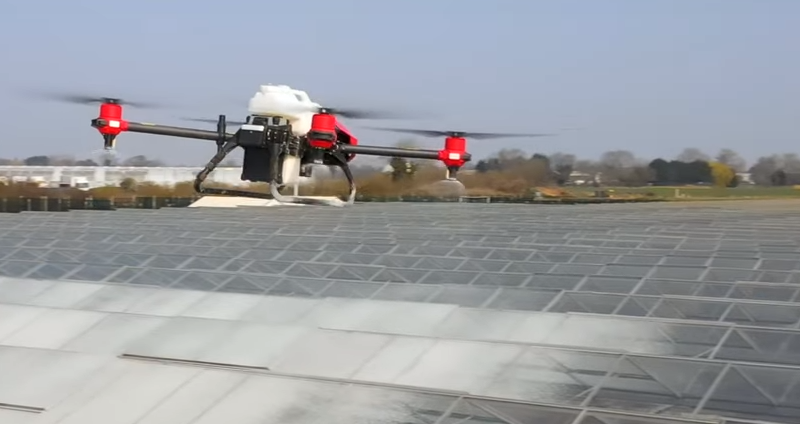
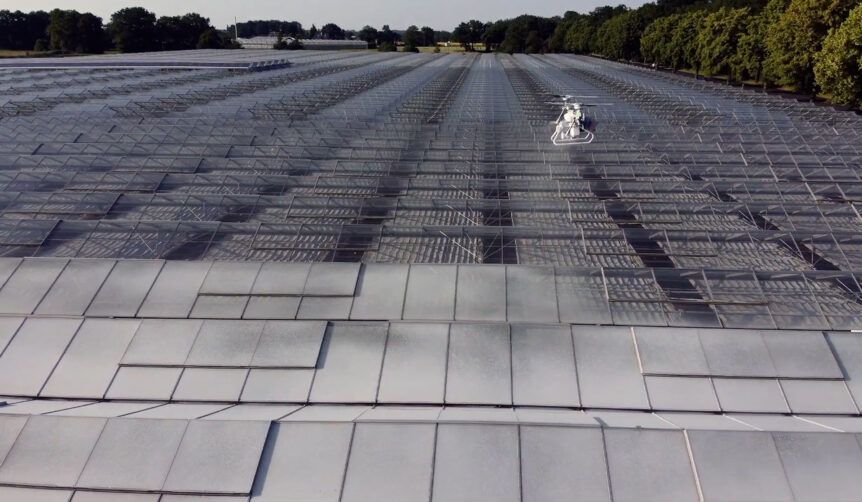
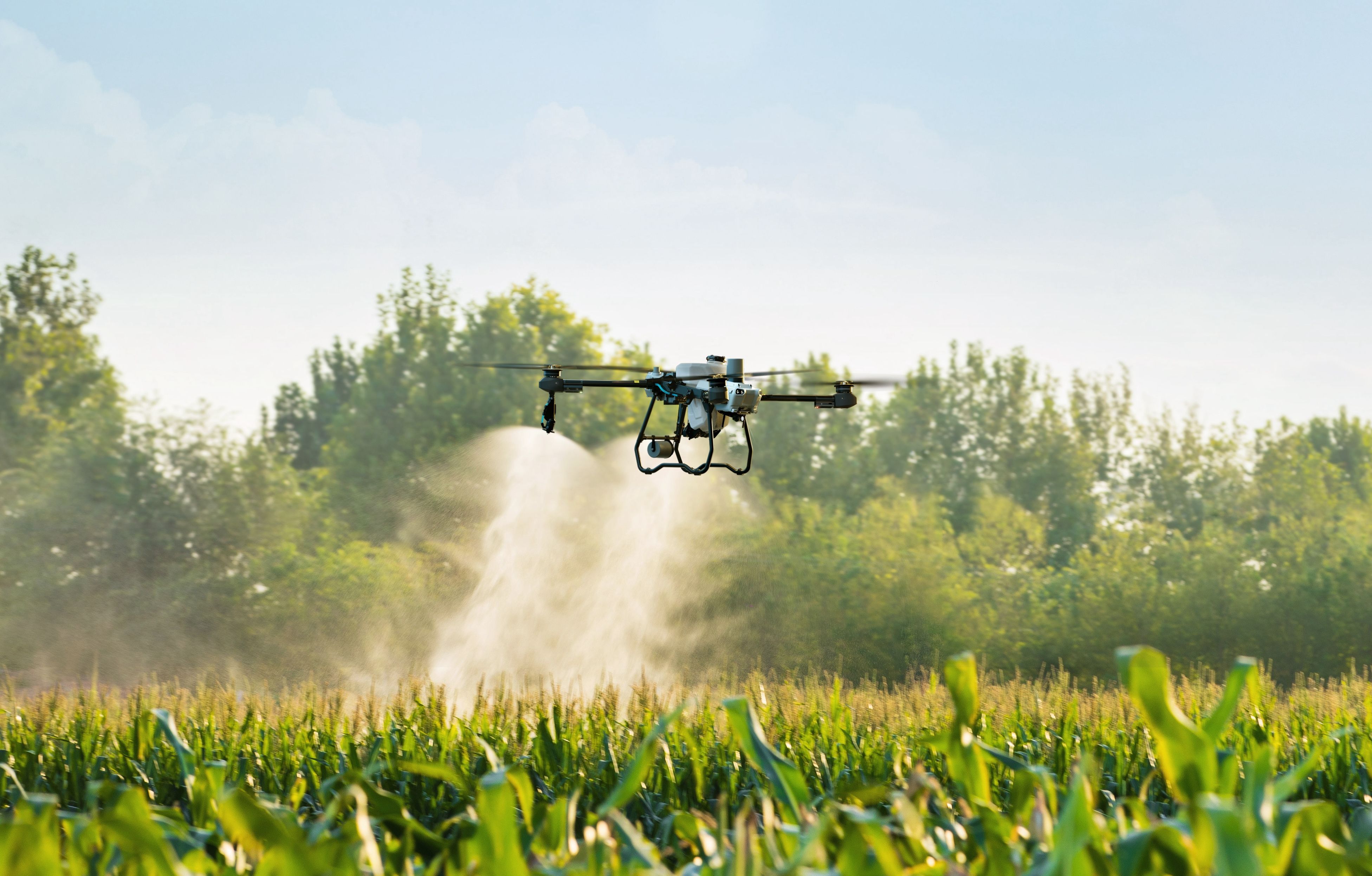
A drone applying shade compound to a greenhouse exterior approaches the work differently from every conventional method. Rather than positioning equipment at or near the roof surface, the drone flies at a controlled altitude above the roof and applies shade compound through a calibrated spray system that delivers uniform coverage across the full roof area with consistent pass spacing.
The drone's GPS-guided flight path is programmed before application begins, defining the coverage area, the altitude above the roof surface, the pass spacing, and the application rate that delivers the target shade compound coverage across the entire roof area. On multi-bay structures with ridge and valley geometry, the flight path accounts for the surface variations to maintain consistent spray distance above the actual panel surface rather than flying a flat path that varies in distance from the undulating roof.
Application coverage consistency from drone application is significantly better than manual methods on complex greenhouse structures because the programmed flight path applies uniform passes across the entire roof area including the edges, valleys, and transitions that manual applicators reach less effectively. The shade compound density across the roof surface is more uniform, which means the interior temperature distribution is more uniform, which means the crop develops more evenly across the full greenhouse area.
The pre-flight planning and calibration that goes into every Specialty Drone Solutions application, including greenhouse shading work, is the foundation of consistent coverage quality. The detailed pre-flight process that precedes every drone application is covered in the article on what happens before a drone ever takes off and why the preparation determines the outcome.
Drone Greenhouse Panel Cleaning
Beyond shade compound application and removal, greenhouse panel cleaning addresses the progressive light transmission loss that dust, pollen, algae, and biological matter accumulation causes over time. A greenhouse panel that has not been cleaned in a season transmits meaningfully less light than a clean panel, which affects the photosynthetically active radiation available to the crop inside.
Drone-based panel cleaning uses water or a mild cleaning solution delivered through the drone's spray system at sufficient pressure and volume to dislodge surface contamination from the panel exterior. The approach is similar to the pressure washing that conventional cleaning uses but without the need to position workers or equipment directly on or adjacent to the roof surface.
Cleaning frequency depends on the local environment around the greenhouse. Southern California's agricultural areas in Ventura, Santa Barbara, and San Luis Obispo counties experience significant dust and pollen loads during the dry season months that accelerate panel contamination. Operations near citrus and avocado orchards encounter dust from harvesting and cultural activities that adds to the contamination load. And operations in areas with high humidity or morning fog experience algae growth on the north-facing panel surfaces that requires more frequent cleaning to maintain light transmission.
The Southern California drone service coverage area and the specific agricultural environments of each county that affect how drone services need to be calibrated for local conditions is covered in the article on drone spraying services in Southern California and how coverage, crops, and conditions vary across the region. The same geographic variation that affects field crop drone applications affects greenhouse maintenance drone services.
Shade Compound Removal in the Fall
The shade compound applied in spring to protect summer crops from radiant heat must be removed in the fall to restore maximum light transmission for the shorter-day winter growing period. Fall removal is as important as spring application for operations that grow year-round, because a greenhouse carrying residual summer shade compound into October and November is limiting the light available to winter crops at the time of year when maximizing light transmission is most critical for crop quality and development rate.
Shade compound removal by drone uses the same spray system as application but with water or a removal solution that breaks down the shade compound and allows it to rinse from the panel surface. The programmed flight path for removal covers the same roof area as the application pass, ensuring that the full compound coverage is addressed rather than leaving residual shade material in areas that are harder to reach.
The timing of fall removal relative to the crops being grown and the transition to winter growing conditions requires coordination with the greenhouse operation's production schedule. Removing shade compound too early in the fall exposes temperature-sensitive summer crops to heat loads they are not prepared for. Removing it too late reduces the light available to crops that are in their critical development phase in November and December. Scheduling the drone removal service around the specific transition timing for the crops and the operation produces better outcomes than scheduling around the drone service provider's availability without considering the crop requirements.
Who Benefits Most From Drone Greenhouse Services in Southern California
Cut Flower and Specialty Crop Greenhouses
Cut flower operations in Ventura and San Diego counties with multi-bay structures covering significant acreage face the full greenhouse maintenance challenge at scale. The scale that makes conventional maintenance expensive and time-consuming is also the scale at which drone application delivers the most significant efficiency advantage. A drone covering an acre of greenhouse roof in a fraction of the time that manual labor requires produces a proportionally larger cost advantage at larger scale.
Nursery Operations
Nursery operations throughout Southern California with permanent greenhouse structures that require consistent light management for container plant production benefit from the coverage uniformity that drone application provides. Inconsistent shade across a nursery greenhouse creates the light variation that produces uneven plant development and reduces the uniformity standards that wholesale nursery customers expect.
Vegetable and Herb Production
Protected vegetable and herb production in Southern California, including the hydroponic and indoor growing operations that have expanded significantly in recent years, operate on crop cycles that create compressed maintenance windows. The installation and removal of shade compounds must happen around crop rotation schedules that do not accommodate the extended downtime of slow manual application. Drone application compressed into a single session allows shade management to happen in the available window between crop cycles without extending into the production period.
Cannabis Greenhouse Operations
Licensed cannabis greenhouse operations in Southern California face the additional constraint that maintenance workers entering the facility require background checks and compliance documentation. Exterior maintenance services including shade compound application and panel cleaning that can be completed from outside the facility perimeter using drone application reduce the number of outside service personnel who need facility access, simplifying the compliance requirements for each maintenance event.
How Drone Application Compares to Manual Methods on Cost
The cost comparison between drone-based and manual greenhouse maintenance depends on the scale of the operation and the current manual labor cost structure.
For small greenhouse operations covering less than half an acre of roof area, the drone service mobilization cost relative to the roof area covered may not produce the cost advantage that becomes clear at larger scale. For operations covering an acre or more of greenhouse roof area, the efficiency advantage of drone coverage relative to manual labor hours typically produces a favorable cost comparison even accounting for the service mobilization.
The comparison should also include the value of the safety risk reduction. The elimination of fall risk from roof walking during shade compound application is a genuine operational benefit that has insurance and liability value beyond the direct labor cost comparison. An operation that has had a roof safety incident or that carries significant insurance exposure for working-at-height activities should factor this risk reduction into the total cost evaluation.
The broader case for how drone services replace conventional application methods in California agriculture, including the safety, efficiency, and coverage quality advantages that apply across field crop and greenhouse applications, is covered in the article on drone spraying versus traditional spraying and which method saves more for California growers.
Scheduling Drone Greenhouse Services in Southern California
Specialty Drone Solutions serves greenhouse operations across Los Angeles, Orange, San Bernardino, Riverside, San Diego, Kern, Ventura, Santa Barbara, San Luis Obispo, and Imperial counties.
Spring shade compound application scheduling should begin before the weather pattern in the specific operation's location shifts to the sustained heat that makes shade protection necessary. In the coastal counties of Ventura and San Diego, this transition typically happens later in the season than in the inland counties of Riverside and San Bernardino where summer heat arrives earlier.
Fall shade compound removal scheduling depends on the operation's winter crop calendar and the local climate transition. The Specialty Drone Solutions team works with greenhouse operators to identify the right timing for both application and removal services based on the specific crops and the production schedule.